
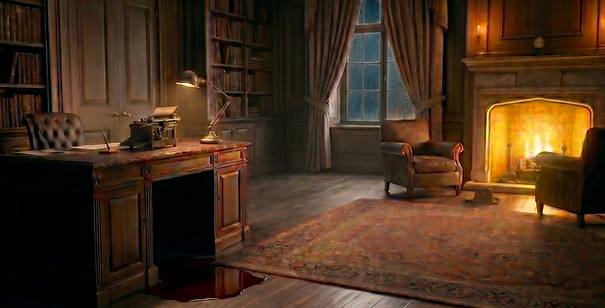
The roots of the impossible crime fiction genre can be traced back to the nineteenth century, when authors began testing the limits of traditional mystery storytelling. The widely acknowledged prototype is Edgar Allan Poe’s 1841 short story, ‘The Murders in the Rue Morgue’, which introduced the concept of a murder committed inside a seemingly inaccessible room. It was the late nineteenth and early twentieth centuries, however, that laid the true groundwork for the genre. Trailblazers such as Israel Zangwill, with The Big Bow Mystery (1892), and Gaston Leroux, with The Mystery of the Yellow Room (1907), elevated the concept from a mere plot device into an intellectual game with intricate mechanical tricks and misdirections.
This period of experimentation paved the way for the Golden Age of Detective Fiction, roughly spanning the 1920s to the 1940s, when the impossible crime truly flourished. During this era, authors like Agatha Christie and Ellery Queen popularised the genre with their ingenious plots. However, it was John Dickson Carr who became the undisputed master of the locked-room mystery, penning classics such as The Hollow Man (1935) and The Judas Window (1938). Alongside Carr, writers like Hake Talbot and Clayton Rawson pushed the boundaries of impossibility even further, blending the aesthetics of the supernatural with strictly logical solutions.
While the popularity of the traditional impossible crime mystery eventually waned in the West in favour of hardboiled thrillers and psychological suspense, the genre thrived elsewhere – most notably in Japan. Japanese authors embraced the honkaku (orthodox) mystery, a subgenre focused intensely on logical deduction and fair-play clues. Seishi Yokomizo’s The Honjin Murders (1946) delivered a brilliant, culturally distinct take on the locked-room formula. In the 1980s, the shin-honkaku (new orthodox) movement revitalised this tradition, with authors like Soji Shimada and Yukito Ayatsuji crafting dizzying, mathematically precise impossible crimes.
Today, the impossible crime is enjoying a vibrant global resurgence. Modern practitioners like Paul Halter proudly carry the mantle of John Dickson Carr, writing wildly imaginative locked-room enigmas. Meanwhile, a wave of newly translated Japanese honkaku and shin-honkaku literature is introducing Western audiences to a universe of meticulously constructed puzzles. Across the globe, readers are rediscovering the unique thrill of the fair-play mystery: the intellectual challenge of being presented with an utterly impossible scenario, knowing that all the clues to crack it are hidden in plain sight.
Serling Lake is an independent UK publisher dedicated to the preservation and revival of the impossible crime and locked-room mystery genre. We are committed to tracking down rare, obscure and long-forgotten puzzle mysteries and making these works more easily available in ebook and paperback formats. If you would like to let us know what you think of our books, or even suggest an old title that we could republish, we would love to hear from you.